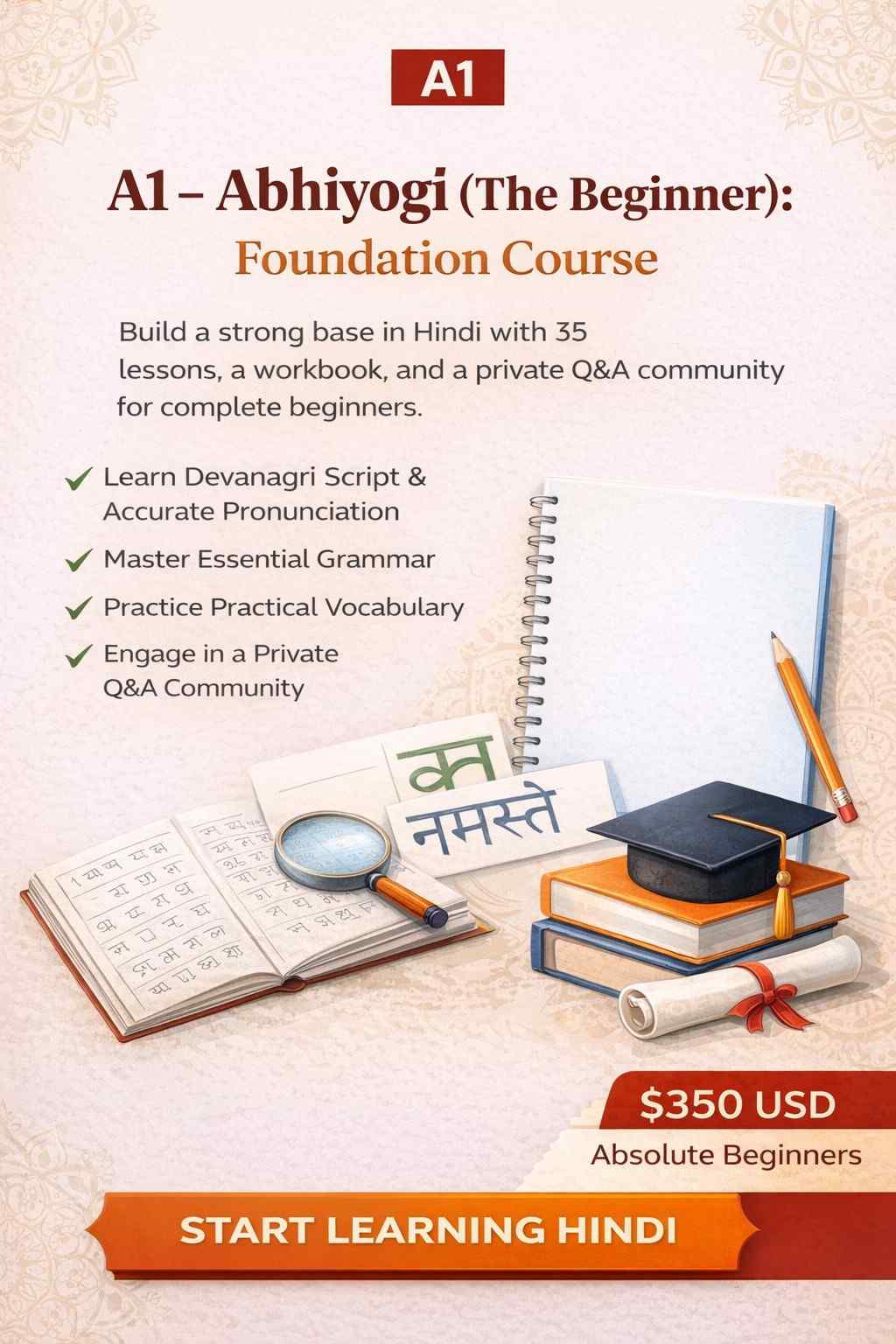
- Target Audience: Absolute beginners with no prior knowledge of Hindi.
- Main Goal: To build a solid foundation in reading and writing the Devanagari script, master basic grammar structures, and acquire essential vocabulary for survival and simple conversation.
- Core Philosophy: “Two Pillars of Learning”: 1) Script & Sound Mastery and 2) Functional Grammar & Vocabulary.
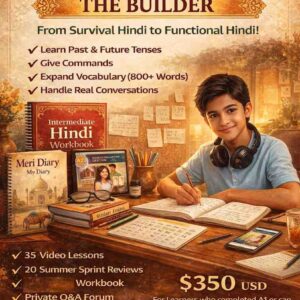
- Price: $350 USD
- Includes:
- 35 x 1-hour lectures on Zoom
- downloadable workbook (PDF).
- Access to a private community forum for Q&A.
- 6 months access to the course materials.
Part 1: The Core Course – 35 Lectures (One Hour Each)
This is the main curriculum, divided into 7 logical modules.
Module 1: The Sacred Script – Devanagari (Lectures 1-5)
- Lecture 1: Welcome & The Landscape of Hindi. Introduction to the course, the speaker, the importance of Hindi. Overview of Devanagari script: the concept of the “line” (shirorekha), vowels and consonants.
- Lecture 2: The Vowels (स्वर – Swar) Part 1. Pronunciation and writing of अ, आ, इ, ई, उ, ऊ. Practice words and tongue twisters.
- Lecture 3: The Vowels (स्वर – Swar) Part 2. Pronunciation and writing of ए, ऐ, ओ, औ, अं, अः. Differentiating between similar sounds (e.g., ए vs. ऐ).
- Lecture 4: The Consonants (व्यंजन – Vyanjan) Part 1 – The Gutturals & Palatals. क-वर्ग (क, ख, ग, घ, ङ) and च-वर्ग (च, छ, ज, झ, ञ). Writing practice and combining with vowels.
- Lecture 5: The Consonants (व्यंजन – Vyanjan) Part 2 – Cerebrals, Dentals & Labials. ट-वर्ग (ट, ठ, ड, ढ, ण), त-वर्ग (त, थ, द, ध, न), and प-वर्ग (प, फ, ब, भ, म). Focus on the dental vs. retroflex distinction.
Module 2: Reading, Writing & First Words (Lectures 6-10)
- Lecture 6: The Semi-vowels, Sibilants, and Aspirate. य, र, ल, व, श, ष, स, ह. Completing the script.
- Lecture 7: The Art of Conjuncts (संयुक्त अक्षर – Sanyukt Akshar). How letters combine (क्ष, त्र, ज्ञ, श्र, and others like न्त, म्प). Reading and writing practice.
- Lecture 8: Reading Practice & Greetings. Reading simple words made from learned letters. Introduction to greetings: नमस्ते, नमस्कार. Good morning/evening. “आप कैसे हैं?”
- Lecture 9: My First Sentences – Introduction to Verbs. The verb “to be” (होना) in the present tense: हूँ, है, हैं. Forming simple sentences: “मैं [Name] हूँ।” “यह क्या है?”
- Lecture 10: Numbers 1-10 & Postpositions का/के/की. Learning to count 1-10. Introduction to the possessive postpositions.
Module 3: The World Around Me (Lectures 11-15)
- Lecture 11: Nouns & Gender. Introduction to grammatical gender (masculine and feminine). Common noun endings.
- Lecture 12: Vocabulary Blast: Family & Relationships. Words for family members (माता, पिता, भाई, बहन). Using possessives with family terms.
- Lecture 13: Present Tense of “Hona” – Full Conjugation. Deep dive into the present tense of होना. Singular and plural forms.
- Lecture 14: Yes/No Questions & Question Words. Forming questions with क्या. Question words: कौन (who), क्या (what), कहाँ (where).
- Lecture 15: Vocabulary Blast: Common Objects. Words for items around the house and classroom (किताब, कलम, मेज़, कुर्सी). Asking “यह क्या है?” and “वह क्या है?”.
Module 4: Actions and Descriptions (Lectures 16-20)
- Lecture 16: Introduction to Adjectives. Basic adjectives: अच्छा, बुरा, बड़ा, छोटा. Adjective agreement with nouns (brief introduction).
- Lecture 17: The Oblique Case – Introduction. The concept of the oblique case and its function with postpositions. Focus on nouns ending in -आ.
- Lecture 18: The Postposition “में” (in). Using में with location words. “किताब मेज़ में है।” (The book is in the desk).
- Lecture 19: Vocabulary Blast: Colors. Learning color names and using them as adjectives.
- Lecture 20: Putting it Together: Describing My Room. A comprehensive practice session combining nouns, adjectives, और (and), and में to describe one’s room.
Module 5: The Present Habitual Tense (Lectures 21-25)
- Lecture 21: Introduction to the Main Verb. The dictionary form (infinitive) of verbs ending in -ना (जाना, पीना, खाना).
- Lecture 22: The Present Habitual Tense – Part 1 (Singular). Conjugating verbs for मैं, तू, तुम, आप. The stem + ता/ती/ते हूँ/है/हो/हैं.
- Lecture 23: The Present Habitual Tense – Part 2 (Plural). Conjugating for हम, वे. Practice with common verbs.
- Lecture 24: Negation. Using नहीं to make negative sentences in the present tense. “मैं नहीं जाता।”
- Lecture 25: Vocabulary Blast: Daily Routine Verbs. Waking up, eating, drinking, going, coming, reading.
Module 6: Navigating the World (Lectures 26-30)
- Lecture 26: To Like & To Want – पसंद and चाहिए. Expressing likes/dislikes (मुझे पसंद है) and wants/needs (मुझे चाहिए).
- Lecture 27: The Postposition “को”. Introduction to the direct/indirect object marker. (Brief overview).
- Lecture 28: Vocabulary Blast: Food & Drink. Extensive vocabulary for Indian and common foods.
- Lecture 29: At the Restaurant – A Functional Dialogue. Role-playing ordering food. Using मुझे… चाहिए and मैं… खाना चाहता हूँ।
- Lecture 30: Numbers 11-100 & Talking about Age/Price. Counting and asking “यह कितने का है?” (How much is this?) and “आपकी उम्र क्या है?” (What is your age?).
Module 7: Bringing It All Together (Lectures 31-35)
- Lecture 31: The Continuous Present Tense – Introduction. Forming “is doing” with रहा है/रही है/रहे हैं.
- Lecture 32: Vocabulary Blast: Directions & Locations. अंदर, बाहर, ऊपर, नीचे, दाएँ, बाएँ.
- Lecture 33: Asking for and Giving Directions. A comprehensive dialogue practice.
- Lecture 34: Cultural Deep Dive: Introductions & Etiquette. Formal vs. informal introductions, touching feet, using “जी”.
- Lecture 35: Course Wrap-up & A1 Level Review. A massive review game covering all major topics. Q&A. Roadmap to A2.
Reviews
There are no reviews yet.