A2 – Abhyāsi (The Practitioner) – “The Builder”
-
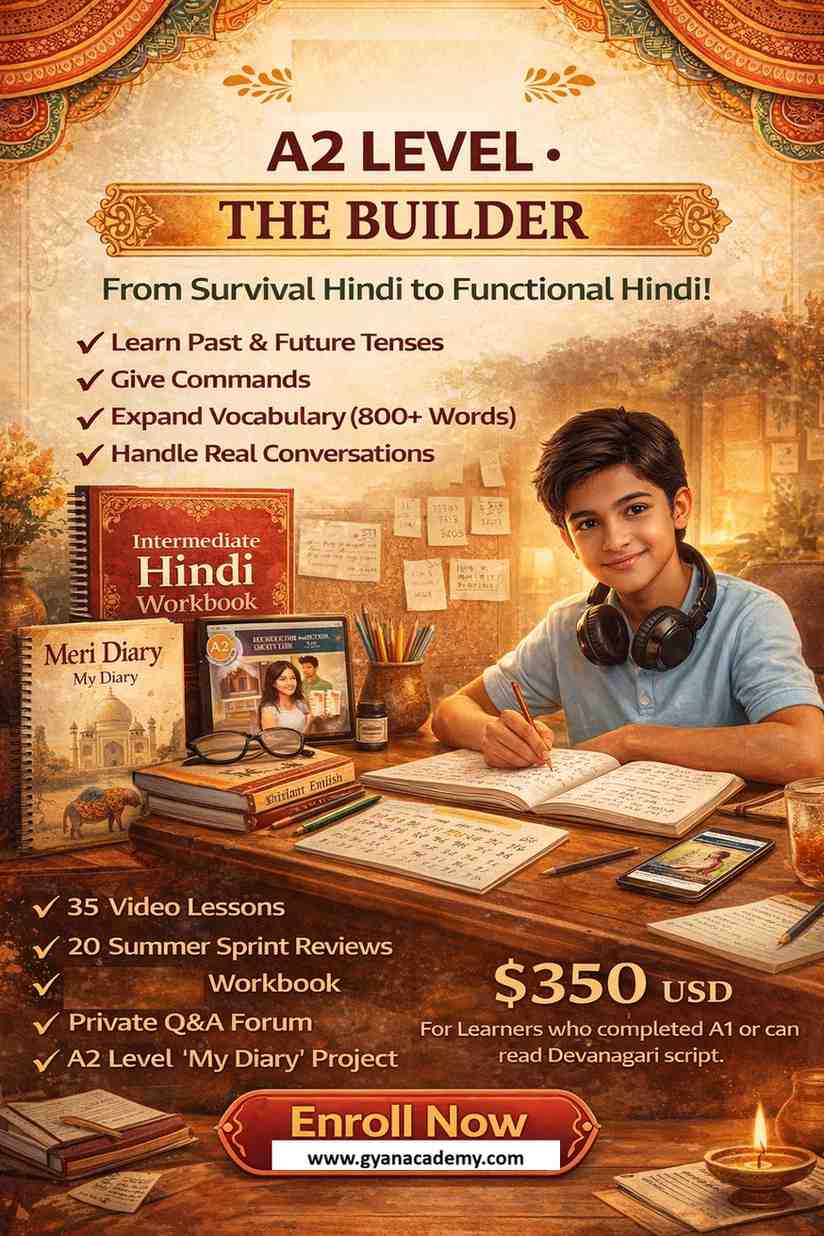
Target Audience: Learners who have completed A1 or can read Devanagari script and form basic present-tense sentences.
-
Main Goal: To move from “survival” to “functional” Hindi. Master the past and future tenses, learn to give commands, handle more complex conversations (shopping, travel, health), and expand vocabulary to 800+ words.
-
Core Philosophy: “From Knowledge to Application.” Every grammar point is immediately tied to a real-life scenario (shopping, traveling, complaining, planning).
-
Price: $350 USD
-
Includes:
-
35 x 1-hour pre-recorded video lectures.
-
20 x 1-hour “Summer Sprint” intensive review/activity lectures.
-
A 220+ page downloadable Workbook (PDF).
-
Access to a private community forum for Q&A.
-
Bonus: A2 Level “Meri Diary” (My Diary) project template.
-
Part 1: The Core Course – 35 Lectures (One Hour Each)
Module 1: Taming the Past – Part 1 (Lectures 1-5)
-
Lecture 1: Welcome to A2 & The Past Tense Landscape. Review of A1. Introduction to the two main past tenses: Perfect (simple past) and Imperfect (habitual past). The concept of “ne” (ने) lurking in the background.
-
Lecture 2: The Present Perfect (Simple Past) – Intransitive Verbs. Forming the past tense for verbs that DON’T take an object (जाना, आना, रहना). Agreement of the verb with the subject (गया/गयी/गये).
-
Lecture 3: Vocabulary Blast: Weekend Activities. Verbs for past events (मिलना, घूमना, खेलना, सोना). Students describe what they did last weekend.
-
Lecture 4: The Present Perfect (Simple Past) – Transitive Verbs. Introduction to the ergative structure: using “ने” (ne) with transitive verbs (करना, खाना, पीना, देखना). Verb agrees with the object, not the subject! (मैंने सेब खाया).
-
Lecture 5: The “Ne” Trap – Common Mistakes. Deep dive into the most common errors with ने. Practice differentiating intransitive vs. transitive sentences.
Module 2: Taming the Past – Part 2 (Lectures 6-10)
-
Lecture 6: The Imperfect Past (Habitual). “I used to…” or “I would…” Forming the past habitual with the stem + ता था/ती थी/ते थे. “जब मैं छोटा था, मैं रोज़ क्रिकेट खेलता था।”
-
Lecture 7: Vocabulary Blast: Childhood Memories. Vocabulary related to school, games, and childhood.
-
Lecture 8: The Past Continuous Tense. “I was doing…” Formation with रहा था/रही थी/रहे थे. “मैं खाना खा रहा था कि फ़ोन बजा।”
-
Lecture 9: Story Time – Putting it All Together (Past). A simple story using all three past tenses. Students identify which tense is used and why.
-
Lecture 10: Numbers 100+ & Dates. Counting to 1000. Months of the year (Hindi calendar). Saying dates (तारीख).
Module 3: Looking Ahead – The Future Tense (Lectures 11-15)
-
Lecture 11: Introduction to the Future Tense. The future marker “गा/गी/गे”. Simple future conjugations (करूँगा, करेगा, करेंगे…).
-
Lecture 12: Making Plans. Using the future tense to make plans with friends. “हम कल फ़िल्म देखने जाएँगे।”
-
Lecture 13: Vocabulary Blast: Hobbies & Interests. Expanding vocabulary to discuss free time activities in the future.
-
Lecture 14: The Subjunctive Mood – A Gentle Introduction. The “might” or “should” form. The base for polite requests and future uncertainty (करूँ, करे, करें). “मैं कल आऊँ?” (Should I come tomorrow?)
-
Lecture 15: “Kal” – The Tricky Word. Understanding how “कल” means both yesterday and tomorrow. Using context to decipher meaning. Other time markers: परसों, नरसों।
Module 4: Giving Orders & Making Requests (Lectures 16-20)
-
Lecture 16: The Imperative Mood – Formal & Informal Commands. How to tell someone to do something. The three levels: तू (intimate/friendly), तुम (familiar), आप (formal/polite). “बैठो,” “बैठिए।”
-
Lecture 17: Polite Requests & “ज़रा”. Softening commands with “ज़रा” (just a little). “ज़रा यहाँ आइए।” Using “कृपया” (please).
-
Lecture 18: Prohibitions – Saying “Don’t!” Using “मत” with commands. “मत जाओ!” (Don’t go!), “इसे मत खाइए।”
-
Lecture 19: Vocabulary Blast: Kitchen & Cooking. Verbs and nouns related to cooking. Giving simple cooking instructions.
-
Lecture 20: Dialogue Practice – Giving Instructions. A boss giving tasks, a mother giving instructions to a child, a friend asking for help.
Module 5: Comparing & Describing Better (Lectures 21-25)
-
Lecture 21: Comparatives & Superlatives. “से” for comparisons. “यह उस से अच्छा है।” “सबसे” for the best/most. “यह सबसे अच्छा है।”
-
Lecture 22: The Postposition “का” – Advanced Usage. Revisiting का/के/की for complex relationships (e.g., “गाड़ी के पहिये” – wheels of the car). Compound postpositions (के पास, के लिए, के बारे में).
-
Lecture 23: Vocabulary Blast: Body Parts & Health. Learning body parts and common ailments (सिरदर्द, बुखार, खांसी).
-
Lecture 24: At the Doctor’s – A Functional Dialogue. Describing symptoms. “मुझे बुखार है,” “मेरे पेट में दर्द हो रहा है।” Understanding simple advice.
-
Lecture 25: “Chahiye” & “Zaroorat” – Needs & Necessity. Advanced usage: “मुझे डॉक्टर को दिखाना चाहिए” (I should see a doctor) vs. “मुझे दवा चाहिए” (I need medicine).
Module 6: Complex Sentences & Connecting Thoughts (Lectures 26-30)
-
Lecture 26: Infinitive Phrases. Using the infinitive (ना form) to link sentences. “मुझे खाना पसंद है।” “वह पानी पीने गया।” (He went to drink water.)
-
Lecture 27: Conjunctions – “Ki” & “Aur”. Using “कि” (that) to connect clauses. “मुझे लगता है कि वह ठीक है।”
-
Lecture 28: Conjunctions – “Agar” (If) & “To” (Then). Introduction to conditional sentences. “अगर बारिश हुई, तो हम नहीं जाएँगे।”
-
Lecture 29: Vocabulary Blast: Travel & Transportation. Words for train, bus, ticket, platform, luggage.
-
Lecture 30: At the Railway Station – A Comprehensive Dialogue. Buying a ticket, asking which platform, asking if the train is on time.
Module 7: Putting It All Together (Lectures 31-35)
-
Lecture 31: Capability (“Sakna”) – Can & Could. Using सकना to express ability in present, past, and future. “मैं हिंदी बोल सकता हूँ।” “मैं नहीं आ सका।”
-
Lecture 32: Obligation (“Parna”) – Have to / Must. Using पड़ना to express compulsion. “मुझे जाना पड़ा।” (I had to go.)
-
Lecture 33: Story Building – “A Day in Mumbai.” A long-form listening/reading comprehension piece using all A2 grammar. Students answer questions and retell the story.
-
Lecture 34: Cultural Deep Dive: Festivals of India. Vocabulary for Holi, Diwali, Eid. How to wish someone. “होली मुबारक,” “दिवाली की शुभकामनाएँ।”
-
Lecture 35: A2 Final Review & “Meri Diary” Project. Comprehensive review game. Introduction to the final project: Writing 5-7 diary entries about their week using past, present, and future tenses. Roadmap to B1.
Reviews
There are no reviews yet.