
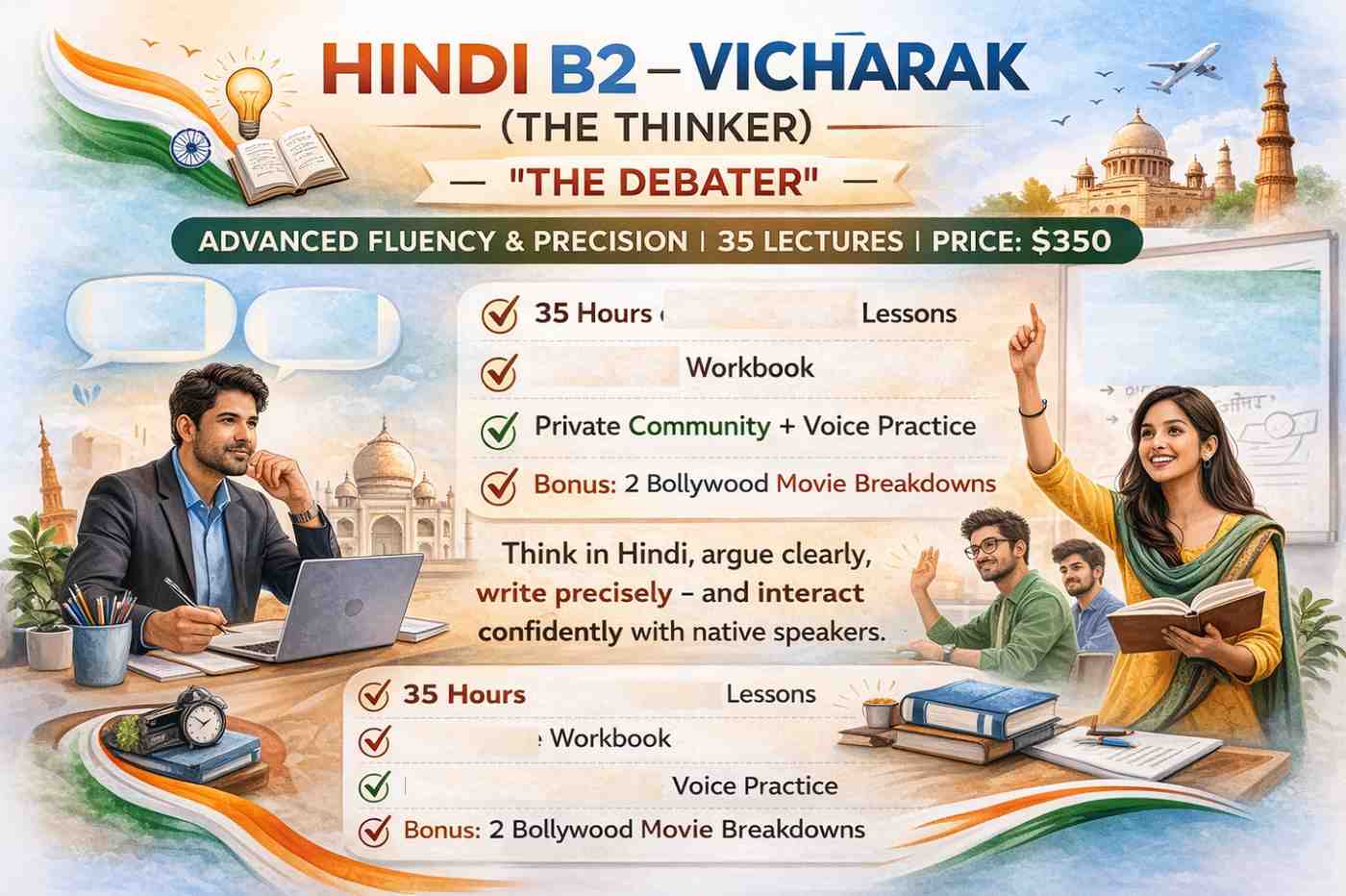
Course Overview: B2 – Vichārak (The Thinker) – “The Debater”(35 Lectures)
-
Target Audience: Learners who have completed B1 or can comfortably hold conversations on familiar topics, express opinions, and understand the main points of complex texts on concrete topics.
-
Main Goal: To achieve a high level of fluency and precision. Students will learn to understand the main ideas of complex texts (both concrete and abstract), interact with a degree of fluency that makes regular interaction with native speakers quite possible without strain, and produce clear, detailed text on a wide range of subjects.
-
Core Philosophy: “Abstraction, Argumentation, and Accuracy.” Grammar shifts from “how to say it” to “how to say it precisely and persuasively.”
-
Price: $350 USD
-
Includes:
-
35 x 1-hour pre-recorded video lectures.
-
downloadable Workbook (PDF) with heavy focus on essay writing, advanced reading comprehension, and precis writing.
-
Access to a private community forum for Q&A and voice note exchanges.
-
Bonus: 2 x Full-Length Bollywood Movie Breakdowns (Dialogue analysis, cultural context, idioms).
-
Part 1: The Core Course – 35 Lectures (One Hour Each)
Module 1: The Nuances of Time & Aspect (Lectures 1-5)
-
Lecture 1: Welcome to B2 & The Landscape of Advanced Hindi. Review of B1. Introduction to the CEFR B2 level goals. The shift from “speaking correctly” to “speaking appropriately.”
-
Lecture 2: The Presumptive Mood – “Hogā”. Expressing assumption, probability, and likelihood in present, past, and future. “वह घर पर होगा।” (He must be at home.) “वह आ गया होगा।” (He must have arrived.) “कल बारिश होगी।” (It will probably rain tomorrow.)
-
Lecture 3: The Subjunctive – Deep Dive. Moving beyond polite requests. Using the subjunctive to express doubt, uncertainty, emotion, and necessity. “हो सकता है कि वह आए।” (It’s possible that he may come.) “ज़रूरी है कि तुम वहाँ जाओ।” (It’s necessary that you go there.)
-
Lecture 4: Participles – Advanced Usage. Using participles as adverbs and in complex phrases. “वह हँसते-हँसते बोला।” (He spoke while laughing.) “खाना खाकर वह सो गया।” (After eating, he slept.)
-
Lecture 5: Vocabulary Blast: Abstract Nouns. Moving beyond concrete objects. Vocabulary for concepts like freedom (स्वतंत्रता), justice (न्याय), responsibility (ज़िम्मेदारी), society (समाज), and culture (संस्कृति).
Module 2: Mastering Complex Sentence Structures (Lectures 6-10)
-
Lecture 6: Compound Verbs – The Remaining Vectors. Deep dive into less common but essential compound verbs: “डालना” (reckless action), “बैठना” (foolish action), “उठना” (sudden beginning), “पड़ना” (compulsion or sudden occurrence). “वह वहाँ जा बैठा।” (He went and sat there foolishly.) “मैं वहाँ जाने से रह गया।” (I missed going there.)
-
Lecture 7: The “Karwānā” Causative – Part 1 (Direct Causative). Making someone do something. The “-wānā” form. “मैंने खाना बनवाया।” (I got the food cooked [by someone].) “माँ बच्चे को खाना खिलाती है।” (The mother feeds the child.)
-
Lecture 8: The “Karwānā” Causative – Part 2 (Double Causative). The ultimate level of causation. Getting something done through an intermediary. “राजा ने महल बनवाया।” (The king got the palace built [by architects, workers, etc.].)
-
Lecture 9: Relative-Correlative – Advanced Constructions. Complex sentences with multiple relative clauses. “जिस आदमी से मैं कल मिला था, उसकी बहन, जो डॉक्टर है, ने मुझे बुलाया।” (The sister of the man I met yesterday, who is a doctor, called me.)
-
Lecture 10: Vocabulary Blast: Work & Professional Life. Vocabulary for meetings (बैठक), deadlines (समय-सीमा), projects (परियोजना), colleagues (सहकर्मी), and negotiations (बातचीत).
Module 3: The Art of Persuasion & Argument (Lectures 11-15)
-
Lecture 11: The Particle System – “To”, “Hi”, “Bhi”, “Bhar”. Mastering these tiny words that carry immense meaning. “मैं तो जाऊँगा ही।” (I, for one, will definitely go.) “वह भी आया।” (He also came.) “उसने यह ही किया।” (He did this very thing.)
-
Lecture 12: Discourse Markers for Debates. “पहली बात तो यह कि…” (First of all…), “दूसरी बात यह कि…” (Secondly…), “इसके विपरीत…” (On the contrary…), “माना कि… लेकिन…” (Granted that… but…), “निस्संदेह…” (Undoubtedly…).
-
Lecture 13: Expressing Certainty vs. Doubt. A spectrum of certainty. “बिल्कुल सच है” (Absolutely true) vs. “शायद” (Maybe) vs. “मुश्किल से” (Hardly/Improbably) vs. “नामुमकिन है” (Impossible).
-
Lecture 14: The Language of Blame & Justification. “उसकी गलती थी” (It was his fault), “मुझे मजबूरन करना पड़ा” (I had no choice but to do it), “यह अनुचित है” (This is unfair).
-
Lecture 15: Formal Debate – Practice Session. A structured debate on a contemporary topic (e.g., “क्या सोशल मीडिया लोकतंत्र के लिए खतरा है?” – Is social media a threat to democracy?). Students are assigned roles and must use advanced discourse markers.
Module 4: Handling Abstract & Professional Topics (Lectures 16-20)
-
Lecture 16: Understanding News & Editorials. Deconstructing a newspaper editorial. Identifying bias, tone, and argument structure. Vocabulary for politics (राजनीति), economy (अर्थव्यवस्था), and policy (नीति).
-
Lecture 17: At the Workplace – Meetings & Presentations. How to give a formal presentation. “आज मैं आपके सामने… प्रस्तुत करने आया हूँ।” “अगला बिंदु है…” “निष्कर्ष के तौर पर…”
-
Lecture 18: Vocabulary Blast: Law & Order. Courtroom and legal vocabulary: अदालत (court), जज (judge), वकील (lawyer), मुकदमा (lawsuit), गवाह (witness), सबूत (evidence), सज़ा (punishment).
-
Lecture 19: Understanding & Telling Jokes. A fun lecture on the structure of Hindi humor. Puns, cultural references, and timing.
-
Lecture 20: Dialogue Practice – A Formal Interview. Roleplaying a job interview or a media interview. Student must answer complex questions professionally.
Module 5: The Passive & Impersonal Constructions (Lectures 21-25)
-
Lecture 21: The Passive Voice – Advanced & Nuanced. Beyond simple “karnā”. Using passive to express inability or a general state. “यहाँ धूम्रपान नहीं किया जाता।” (Smoking is not done here – it’s not allowed/a custom.) “मुझसे यह काम नहीं हुआ।” (I couldn’t do this work – lit: This work was not done by me.)
-
Lecture 22: Impersonal Constructions. Using passive to create impersonal expressions. “ऐसा कहा जाता है कि…” (It is said that…), “माना जाता है कि…” (It is believed that…)
-
Lecture 23: The “Ne” Construction with Body Parts & Emotions. “उसे दिल का दौरा पड़ा।” (He had a heart attack.) “मुझे ज़ोर से ठंड लगी।” (I felt very cold.) “बच्चे को भूख लगी है।” (The child is hungry.)
-
Lecture 24: Vocabulary Blast: Health & Medicine – Advanced. Specialist terms: ब्लड प्रेशर (blood pressure), शुगर (diabetes/diabetic), इलाज (treatment), ऑपरेशन (surgery), दवा खुराक (dosage).
-
Lecture 25: At the Hospital – A Complex Scenario. A detailed roleplay involving a medical emergency, interacting with doctors, and understanding a diagnosis.
Module 6: The World of Idioms & Figurative Language (Lectures 26-30)
-
Lecture 26: Introduction to Hindi Idioms (मुहावरे). What are idioms and why are they crucial for fluency. Common idioms with body parts. “सिर पर चढ़ना” (to pamper someone excessively), “नाक में दम करना” (to annoy someone).
-
Lecture 27: Proverbs (कहावतें) – Wisdom in a Phrase. Common proverbs and their meanings. “नाच न जाने आँगन टेढ़ा।” (A bad workman blames his tools.) “दूध का जला छाछ भी फूँक-फूँक कर पीता है।” (Once bitten, twice shy.)
-
Lecture 28: Figurative Language in Literature. Reading a short poem or an excerpt from a Hindi story. Analyzing metaphors (रूपक) and similes (उपमा).
-
Lecture 29: Vocabulary Blast: Literature & Arts. Words for poetry (कविता), story (कहानी), novel (उपन्यास), painter (चित्रकार), melody (राग), and performance (प्रदर्शन).
-
Lecture 30: Song Analysis – Poetry in Motion. Analyzing a classic Ghazal or a sophisticated Bollywood song for its poetic devices, idioms, and double meanings.
Module 7: Synthesis & Fluency (Lectures 31-35)
-
Lecture 31: Register & Style – Formal vs. Informal. Understanding when to use highly Sanskritized Hindi (शुद्ध हिंदी) vs. everyday Hindustani. Code-switching with English.
-
Lecture 32: Summarizing & Paraphrasing. Learning to summarize a complex article or speech in one’s own words (Precis writing). A key skill for B2.
-
Lecture 33: Expressing Hypothetical Scenarios in Depth. Complex “what if” scenarios using all the conditional tools learned. “अगर मैं वहाँ होता, तो शायद मैं भी ऐसा ही करता, लेकिन मुझे लगता है कि उसका तरीका गलत था।”
-
Lecture 34: Cultural Deep Dive: Regional Variations. A brief introduction to how Hindi changes across states (e.g., Bambaiya Hindi, Punjabi-infused Hindi, Bhojpuri influence). Understanding different accents and slang.
-
Lecture 35: B2 Final Review & “The Essay Project”. Comprehensive review game. Introduction to the final project: A 1000-word essay on a topic of social, cultural, or political significance (e.g., “जलवायु परिवर्तन और भारत” – Climate Change and India, “आधुनिक भारत में नारीवाद” – Feminism in Modern India).
Reviews
There are no reviews yet.