
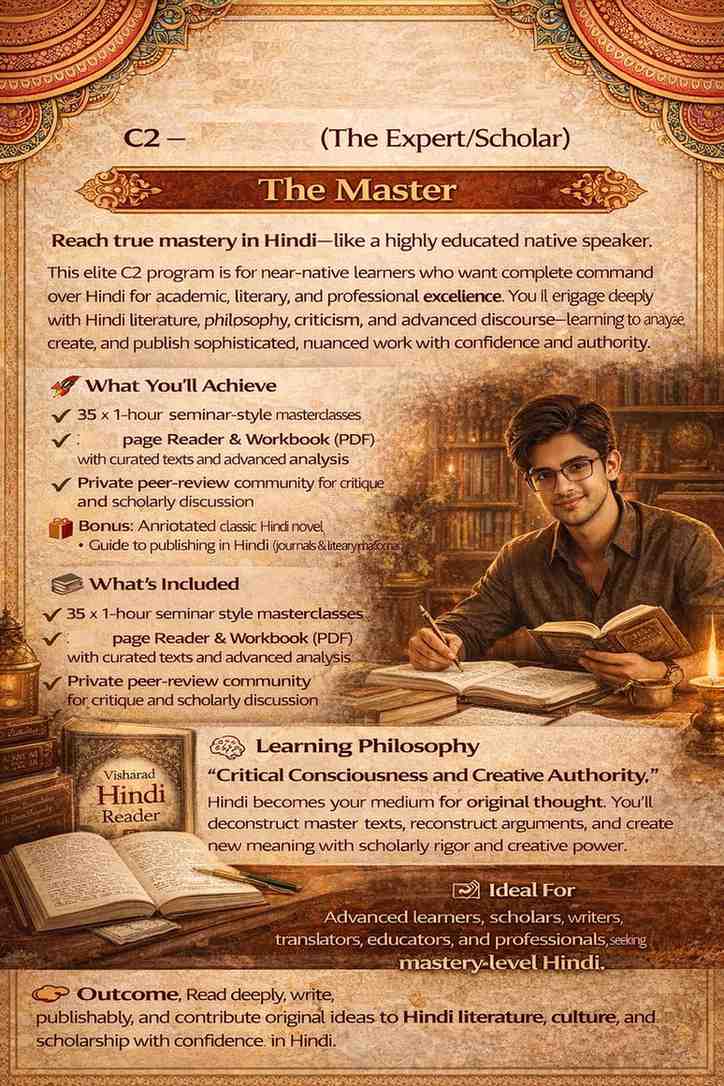
Course Overview: C2 – Vishārad (The Expert/Scholar) – “The Master”
-
Target Audience: Learners who have completed C1 or have near-native fluency. They can understand with ease virtually everything heard or read. They can summarise information from different spoken and written sources, reconstructing arguments and accounts in a coherent presentation. They can express themselves spontaneously, very fluently and precisely, differentiating finer shades of meaning even in the most complex situations.
-
Main Goal: To achieve mastery equivalent to a highly educated native speaker. Students will learn to understand and appreciate the full depth of Hindi literature, philosophy, and critical discourse. They will be able to produce sophisticated, nuanced, and stylistically appropriate texts for academic and professional publication. They will develop a critical awareness of regional, historical, and social registers of Hindi.
-
Core Philosophy: “Critical Consciousness and Creative Authority.” Language is no longer a tool but a medium for original thought and contribution to knowledge. The focus is on deconstruction, reconstruction, and the creation of new meaning.
-
Price: $350 USD
-
Includes:
-
35 x 1-hour lectures
-
A downloadable “Reader” & Workbook (PDF) – a curated anthology of texts with advanced analytical exercises.
-
Access to a private community forum for peer-reviewed discussion and critique.
-
Bonus: 1 x Complete Classic Hindi Novel (Full Text with Scholarly Annotations) + 1 x Guide to Publishing in Hindi (Academic and Literary Journals).
-
Part 1: The Core Course – 35 Lectures (One Hour Each)
Module 1: The Philosophical Foundations of Hindi (Lectures 1-5)
-
Lecture 1: Welcome to C2 – The Landscape of Mastery. Review of C1. Introduction to CEFR C2 goals. The shift from “using the language” to “inhabiting the language.” Understanding the concept of bhāṣā kā saundaryaśāstra (linguistic aesthetics).
-
Lecture 2: The Roots of Modern Hindi – A Historical Overview. A brief but deep look into the evolution of Hindi from Śaurasenī Apabhraṃśa, through Braj Bhasha and Awadhi, to Khari Boli and Modern Standard Hindi. Understanding the linguistic layers in contemporary Hindi.
-
Lecture 3: Tadsam vs. Tadbhav vs. Deshaj. The three lexical streams of Hindi. Understanding the origin and stylistic impact of Sanskrit-derived (tatsam), naturally evolved (tadbhav), and indigenous (deshaj) words. Why a writer chooses “वर्षा” (tatsam) over “बारिश” (tadbhav) or “मेह” (deshaj).
-
Lecture 4: Perso-Arabic Influence on Hindi. The deep impact of Persian and Arabic on Hindi vocabulary, syntax, and register. Understanding the “Hindustani” continuum. When to use “इन्तज़ार” and when to use “प्रतीक्षा.”
-
Lecture 5: Vocabulary Blast: The Language of Aesthetics & Criticism. Advanced vocabulary for discussing art, literature, and culture: सौन्दर्यशास्त्र (aesthetics), अलंकार (figures of speech), रस (aesthetic emotion), ध्वनि (suggestion), वक्रोक्ति (oblique expression), छायावाद (romanticism), प्रयोगवाद (experimentalism).
Module 2: Advanced Grammatical Structures – The Unwritten Rules (Lectures 6-10)
-
Lecture 6: The Syntax of Emphasis – Beyond Particles. How word order itself creates emphasis and nuance in native speech. The “marked” vs. “unmarked” sentence. “मैंने उसे देखा था” (I had seen him) vs. “उसे देखा था मैंने” (Him, I had seen – emphasis on the object).
-
Lecture 7: Ellipsis & Implied Meaning. What native speakers leave out. Understanding sentences where subjects, objects, and even verbs are omitted because context makes them clear. Analyzing dialogues from literature for elliptical constructions.
-
Lecture 8: The Rare Compound Verbs. Moving beyond the common 6-8 vectors. Verbs like “निकलना” as a vector (भाग निकला – ran away), “लौटना” (आ लौटा – came back emphatically), “चुकना” (आ चुका – has already arrived).
-
Lecture 9: The Inceptive, Durative, and Terminative Aspects. Expressing the beginning, continuation, and end of an action with nuance. “लगना” for inception (बोलने लगा – started speaking), “रहना” for duration (बोलता रहा – kept speaking), “चुकना” for completion (बोल चुका – finished speaking).
-
Lecture 10: Vocabulary Blast: The Language of Time & Space in Philosophy. Terms from Indian philosophy that require deep understanding: काल (time), दिक् (space), कार्य-कारण (causality), सत्य (truth), असत्य (falsehood), मिथ्या (illusory).
Module 3: Decoding the Masters – Literature Seminar (Lectures 11-15)
-
Lecture 11: Premchand – A Critical Re-evaluation. Reading a full Premchand story (e.g., “कफ़न” – The Shroud) with a critical lens. Moving beyond plot to analyze his narrative technique, use of dialect, and his complex portrayal of caste and class. Seminar discussion.
-
Lecture 12: The Chhayavaad Poets – Nirala, Pant, Mahadevi. Deep analysis of 2-3 signature poems. Understanding their use of nature imagery, their exploration of the self, and their linguistic innovation. Seminar discussion.
-
Lecture 13: The Nayi Kahani Movement – Mohan Rakesh / Kamleshwar. Introduction to the “New Story” movement of the 1950s-60s. Reading a story that focuses on urban alienation and psychological realism. Analyzing the shift from social realism to individual angst.
-
Lecture 14: Modern Hindi Drama – Mohan Rakesh’s “आधे-अधूरे”. Reading and analyzing an excerpt from this landmark play. Understanding the symbolism of the “half-formed” characters and the language of familial conflict.
-
Lecture 15: Dalit & Adivasi Literature – A New Voice. Introduction to the powerful counter-narrative in Hindi literature. Reading a short poem or story by a Dalit or Adivasi writer. Analyzing the language of resistance and the reclaiming of identity. (e.g., Omprakash Valmiki, Kusum Meghwal).
Module 4: The Critic’s Eye – Analysis & Interpretation (Lectures 16-20)
-
Lecture 16: The Art of the Literary Essay. Reading a classic Hindi literary essay (निबंध) by a master like Hazari Prasad Dwivedi or Vidya Niwas Mishra. Analyzing their prose style, erudition, and the art of weaving personal reflection with scholarship.
-
Lecture 17: Comparative Literature – Hindi and English/Other. A workshop comparing a Hindi text with a similar text from another language (in translation). Analyzing how different literary traditions treat a universal theme (e.g., love, death, nature).
-
Lecture 18: Translation Theory & Practice – Advanced. A deep dive into the challenges of translating literature. Discussing concepts like “untranslatability,” “domestication” vs. “foreignization,” and the ethics of translation. Students present critiques of existing translations.
-
Lecture 19: Writing a Critical Review. Learning to write a scholarly book review or film review for publication. Structure, tone, and the art of balanced critique. Students write a review of a contemporary Hindi novel or film.
-
Lecture 20: Seminar – Student-Led Discussion. A student presents a critical analysis of a text of their choice, and the class (guided by the teacher) engages in a formal seminar discussion.
Module 5: The Professional Scholar – Academic & Formal Hindi (Lectures 21-25)
-
Lecture 21: The Structure of a Research Paper. Understanding the conventions of academic writing in Hindi. Abstract (सारांश), Introduction (भूमिका), Literature Review (साहित्य समीक्षा), Methodology (पद्धति), Analysis (विश्लेषण), Conclusion (निष्कर्ष), Bibliography (ग्रंथ सूची).
-
Lecture 22: Citing Sources & Creating a Bibliography. How to cite books, articles, and online sources in Hindi academic style. Understanding the Devanagari script for bibliographies.
-
Lecture 23: Formal Addresses & Commemorative Speeches. Analyzing the language of formal addresses given on occasions like Republic Day or at academic conferences. The use of highly Sanskritized vocabulary and elaborate honorifics.
-
Lecture 24: Legal & Government Hindi. Understanding the specific register of legal documents, government orders (आदेश), and official notifications (अधिसूचना). “बाबू” style and its complexities.
-
Lecture 25: Vocabulary Blast: The Language of Scholarship. Terms essential for academic life: शोध-प्रस्ताव (research proposal), पाण्डुलिपि (manuscript), प्रकाशक (publisher), संपादक (editor), उद्धरण (quotation), टिप्पणी (footnote/commentary).
Module 6: The Living Language – Dialects, Registers & Change (Lectures 26-30)
-
Lecture 26: Understanding Braj Bhasha. The language of Krishna devotion and classical poetry. Reading a famous Bhajan or a couplet from Surdas. Understanding its grammar and vocabulary as a distinct, yet related, system to modern Hindi.
-
Lecture 27: Understanding Awadhi. The language of the Ramayana (Tulsidas). Reading a few chaupais from the Ramcharitmanas. Appreciating its epic cadence and vocabulary.
-
Lecture 28: Bhojpuri & Magahi – The Languages of the East. Introduction to the linguistic landscape of Eastern Uttar Pradesh and Bihar. Understanding common Bhojpuri words and phrases that have entered popular culture (especially through Bhojpuri cinema and music).
-
Lecture 29: The Urban Vernacular – Bambaiya & Hinglish. Analyzing the unique slang of Mumbai. How Hindi and English blend seamlessly in urban youth culture. The grammar and vocabulary of “Hinglish.”
-
Lecture 30: The Future of Hindi – Digital & Global. Discussion on how Hindi is evolving in the digital age. New vocabulary for technology, internet memes, and social media discourse. The role of Hindi in the global diaspora.
Module 7: The Capstone – Original Contribution (Lectures 31-35)
-
Lecture 31: Project Proposal Presentations. Each student presents their Capstone Project proposal to the class for feedback. The proposal can be:
-
A substantial research paper (4000-5000 words) on a linguistic, literary, or cultural topic.
-
A complete, publishable translation of a significant work (short story, play, or book chapter) with a critical introduction.
-
An original creative work: a collection of poems, a short story, or a one-act play.
-
-
Lecture 32: Methodology Workshop. For research students: refining methodology. For translation students: discussing challenges and solutions. For creative writers: workshopping drafts.
-
Lecture 33: Peer Review Session. Students exchange drafts of their work and provide structured, critical feedback to each other using a provided rubric.
-
Lecture 34: Final Edits & Polish. One-on-one consultations with the teacher (in a group setting) to finalize the project. Focus on stylistic refinement, citation accuracy, and overall presentation.
-
Lecture 35: Graduation & The Road Ahead. Final presentations of project findings or readings from creative work. Celebration of achievement. A final lecture on how to continue engaging with Hindi at the mastery level: joining scholarly associations, subscribing to literary journals, finding writing mentors, and contributing to the global community of Hindi speakers and scholars.
Reviews
There are no reviews yet.