
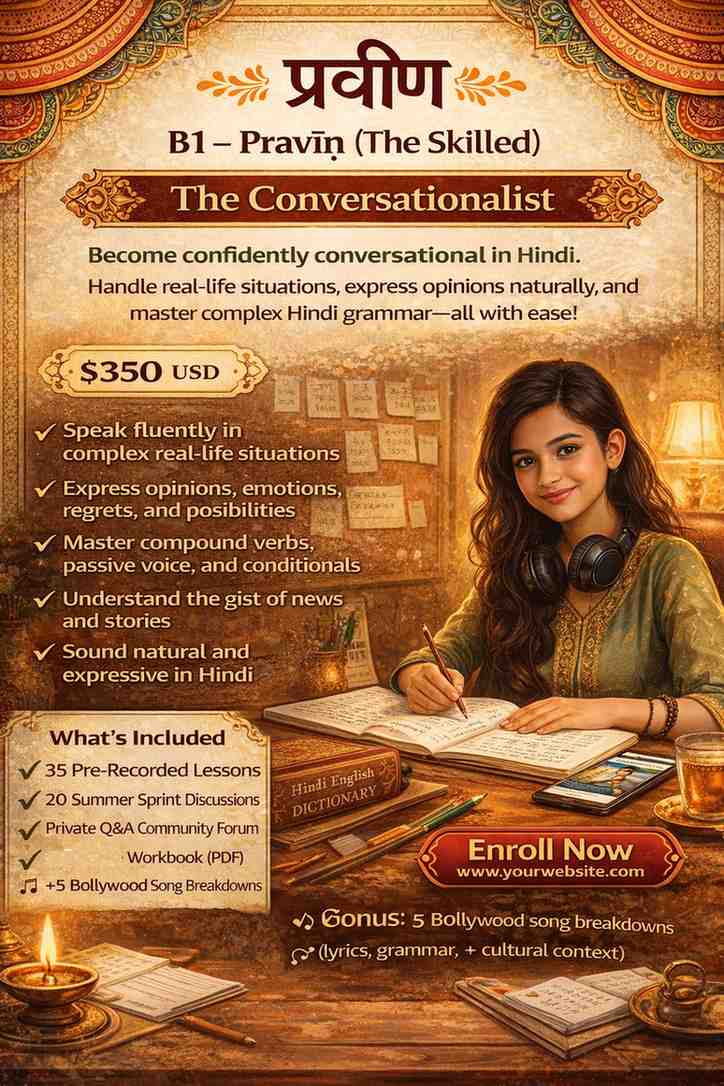
Course Overview: B1 – Pravīṇ (The Skilled) – “The Conversationalist”
-
Target Audience: Learners who have completed A2 or can comfortably talk about past, present, and future events related to personal life.
-
Main Goal: To achieve conversational independence. Students will learn to handle complex situations (banking, complaining, emergencies), express opinions and emotions, understand the gist of news and stories, and master the core compound verb system.
-
Core Philosophy: “Opinions, Emotions, and Efficiency.” Grammar shifts from “what happened” to “how it happened” and “how I felt about it.”
-
Price: $350 USD
-
Includes:
-
35 x 1-hour lectures. which includes 20 x 1-hour ” ” intensive discussion-based lectures.
-
A downloadable Workbook (PDF) with heavy focus on open-ended writing.
-
Access to a private community forum for Q&A and voice note exchanges.
-
Bonus: 5 x Bollywood Song Breakdowns (Lyrics analysis).
-
Part 1: The Core Course – 35 Lectures (One Hour Each)
Module 1: Complex Sentences & Conditionals (Lectures 1-5)
-
Lecture 1: Welcome to B1 & The World of “If/Then”. Review of A2. Introduction to the complex conditional mood. The difference between possible (अगर हुआ तो) and hypothetical (अगर होता तो) situations.
-
Lecture 2: Real Conditionals – Present and Future. “अगर बारिश हुई, तो हम नहीं जाएँगे।” (If it rains, we won’t go.) “अगर वह आता है, तो मुझे बताना।” (If he comes, tell me.)
-
Lecture 3: Unreal Conditionals – Present Hypothetical. “अगर मैं अमीर होता, तो एक कार खरीदता।” (If I were rich, I would buy a car.) Introduction to the past subjunctive (होता, करता).
-
Lecture 4: Unreal Conditionals – Past Hypothetical (Regrets). “अगर तुमने बताया होता, तो मैं आ गया होता।” (If you had told me, I would have come.) Expressing regret and missed opportunities.
-
Lecture 5: Vocabulary Blast: Ambition & Dreams. Vocabulary related to careers, goals, and fantasies to practice hypothetical situations.
Module 2: Mastering the Compound Verbs (Lectures 6-10)
-
Lecture 6: Introduction to Compound Verbs – The “Vectors”. The concept of the “main verb” + “helper verb” (जाना, लेना, देना, डालना, बैठना, उठना). Why “खा लिया” is different from just “खाया”.
-
Lecture 7: Completion & Intensity – जाना & डालना. “जाना” for change of state or completion (बैठ गया, खो गया, मर गया). “डालना” for doing something with force or recklessness (पी डाला, खा डाला).
-
Lecture 8: Benefit & Self-Interest – लेना & देना. “लेना” for doing something for oneself (सीख लिया). “देना” for doing something for someone else (समझा दिया).
-
Lecture 9: Inception & Sudden Action – बैठना, उठना, पड़ना. “बैठना” for sitting down to do something (सोच बैठा). “उठना” for starting an action (दौड़ उठा). “पड़ना” for sudden or involuntary action (रो पड़ा).
-
Lecture 10: Compound Verb Blitz – Identifying Nuance. A workshop-style lecture with many example sentences. Students must identify the compound verb and explain the nuance it adds.
Module 3: Expressing Emotions & Opinions (Lectures 11-15)
-
Lecture 11: The Experiential Tense – “कर चुका हूँ”. Expressing that you have already done something (and it’s finished). “मैं ताजमहल देख चुका हूँ।” (I have already seen the Taj Mahal.)
-
Lecture 12: Emotive Verbs & The Dative Subject. Revisiting “को” with feelings. “मुझे खुशी हुई” (I felt happy), “मुझे गुस्सा आया” (I got angry), “मुझे नींद आ रही है” (I’m feeling sleepy).
-
Lecture 13: Vocabulary Blast: Emotions & Personality. Extensive vocabulary for feelings (निराश, उत्साहित, चिंतित, गर्व) and personality traits.
-
Lecture 14: Giving Opinions – “मेरे ख़याल से”, “मुझे लगता है”. Framing opinions. Agreeing and disagreeing politely. “मैं सहमत हूँ,” “मैं असहमत हूँ,” “हाँ, पर…”
-
Lecture 15: Debate Club – A Simple Topic. A moderated discussion on a simple topic (e.g., “City life vs. Village life”) using learned opinion phrases and vocabulary.
Module 4: Navigating Complex Situations (Lectures 16-20)
-
Lecture 16: At the Bank – Formal Language. Vocabulary for banking: खाता (account), पैसे जमा करना (deposit), निकालना (withdraw), फ़ॉर्म भरना (fill form).
-
Lecture 17: At the Police Station / Lost & Found. Vocabulary for emergencies: चोरी (theft), खो गया (lost), शिकायत (complaint). Describing an incident in detail.
-
Lecture 18: At the Hospital – Describing Symptoms in Detail. Moving beyond “सिरदर्द”. “मुझे उल्टी आ रही है,” ” “मुझे एलर्जी है।”
-
Lecture 19: Making a Complaint – Effective Communication. How to complain about a product or service politely but firmly. “मैंने यह कल खरीदा था, लेकिन यह खराब है।”
-
Lecture 20: Dialogue Practice – Roleplay Day. Students are given roles (bank manager, customer, doctor, patient) and must navigate a complex scenario.
Module 5: The Passive Voice & Indirect Speech (Lectures 21-25)
-
Lecture 21: Introduction to the Passive Voice. “किया गया” vs. “हो गया”. The concept of the action being done without focusing on the doer. “यह काम कल किया जाएगा।” (This work will be done tomorrow.)
-
Lecture 22: Passive Voice in All Tenses. Forming passive sentences in present, past, and future. “खाना पकाया जा रहा है।” (The food is being cooked.)
-
Lecture 23: Reported Speech – Part 1 (Statements). “उसने कहा कि वह आएगा।” (He said that he will come.) Backshifting of tenses (optional in Hindi, but nuances explained).
-
Lecture 24: Reported Speech – Part 2 (Questions & Commands). “उसने पूछा कि तुम कहाँ जा रहे हो।” (He asked where you were going.) “उसने कहा कि चले जाओ।” (He told me to go away.)
-
Lecture 25: News Headline Analysis. Reading simple news headlines and short articles. Identifying passive voice and reported speech.
Module 6: Connecting Ideas Like a Native (Lectures 26-30)
-
Lecture 26: Advanced Conjunctions – “जैसे ही”, “जब तक”, “जितना”. “जैसे ही वह आया, बारिश शुरू हो गई।” (As soon as he came, it started raining.) “जब तक तुम नहीं आओगे, मैं नहीं जाऊँगा।” (I won’t go until you come.)
-
Lecture 27: Relative-Correlative Sentences. The beautiful “जो…वो” structure. “जो लोग मेहनत करते हैं, वो सफल होते हैं।” (Those who work hard, they succeed.)
-
Lecture 28: Vocabulary Blast: Environment & Nature. पेड़-पौधे, मौसम, प्रदूषण, बचाव (trees, weather, pollution, conservation).
-
Lecture 29: Expressing Cause and Purpose. “क्योंकि” (because), “इसलिए” (therefore), “ताकि” (so that). “मैं जल्दी सो गया ताकि सुबह जल्दी उठ सकूँ।”
-
Lecture 30: Story Building – “An Unfortunate Event.” Students collaboratively build a story about a theft or an accident, using all the complex structures learned so far.
Module 7: Fluency & Cultural Nuance (Lectures 31-35)
-
Lecture 31: Participles as Adjectives. Using verb forms as adjectives. “जलता हुआ घर” (the burning house), “बिखरे हुए कपड़े” (scattered clothes), “थका हुआ आदमी” (tired man).
-
Lecture 32: Diminutives & Expressiveness. Adding “सा” to words for a softer, more approximate meaning. “थोड़ा सा” (a little bit), “गोरा सा” (whitish), “अच्छा सा” (nice-ish).
-
Lecture 33: Understanding Humor & Sarcasm. A light-hearted lecture on how humor works in Hindi. Common funny phrases and how to detect sarcasm.
-
Lecture 34: Cultural Deep Dive: Bollywood & Music. Analyzing a popular song’s lyrics for grammar, metaphor, and cultural context.
-
Lecture 35: B1 Final Review & “The Monologue Project”. Comprehensive review. Introduction to the final project: A 3-5 minute recorded monologue on a topic of choice (e.g., “My biggest regret,” “My plan for the next 5 years,” “A social issue I care about”). .



Reviews
There are no reviews yet.