
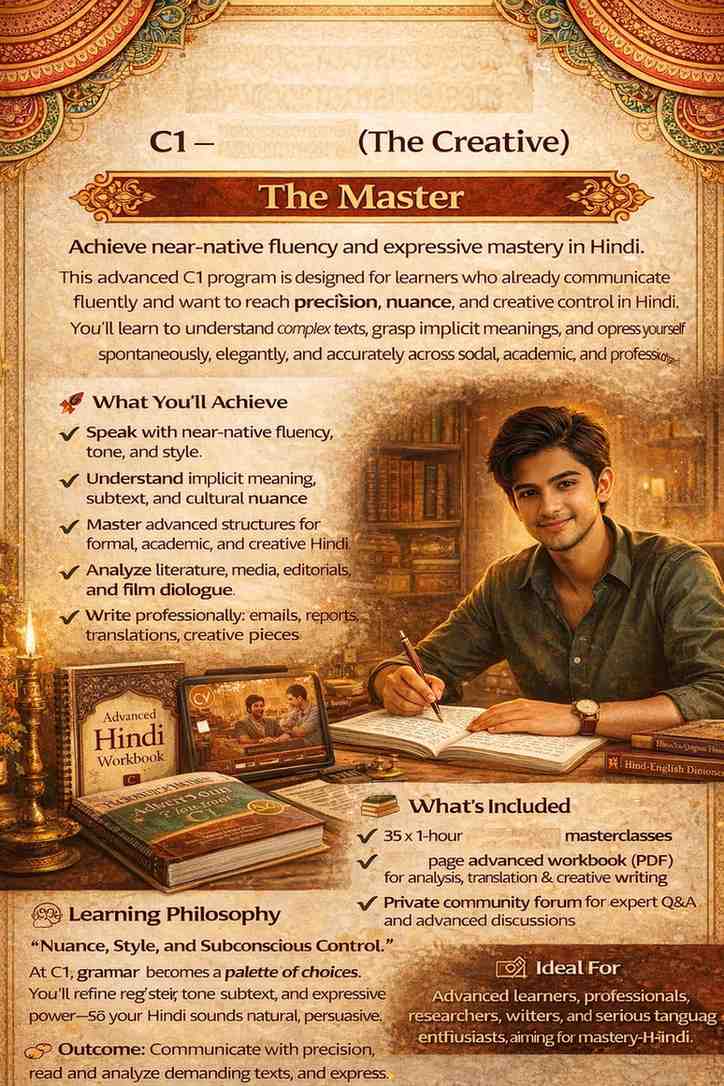
Course Overview: C1 – The Creative – “The Master”
-
Target Audience: Learners who have completed B2 or can confidently handle complex academic/professional topics, express themselves fluently and spontaneously without much obvious searching for expressions, and use language flexibly and effectively for social, academic, and professional purposes.
-
Main Goal: To achieve near-native fluency and precision. Students will learn to understand a wide range of demanding, longer texts, and recognize implicit meaning. They will be able to express themselves spontaneously, very fluently and precisely, differentiating finer shades of meaning even in the most complex situations.
-
Core Philosophy: “Nuance, Style, and Subconscious Control.” Grammar is no longer a set of rules but a palette of choices. The focus is on register, tone, subtext, and creative expression.
-
Price: $350 USD
-
Includes:
-
35 x 1-hour lectures.
-
A downloadable Workbook (PDF) with focus on critical analysis, translation, and creative writing.
-
Access to a private community forum for Q&A and advanced discussion groups.
-
Bonus: 1 x Full-Length Classic Hindi Novel Study Guide (with chapter-wise vocabulary and analysis) + 1 x Acclaimed Hindi Film (Parallel Cinema) Deep-Dive Course.
-
Part 1: The Core Course – 35 Lectures (One Hour Each)
Module 1: The Architecture of Complex Ideas (Lectures 1-5)
-
Lecture 1: Welcome to C1 – The Landscape of Mastery. Review of B2. Introduction to CEFR C1 goals. The shift from “using language” to “playing with language.” Understanding the concept of “register” (औपचारिक vs. अनौपचारिक, साहित्यिक vs. बोलचाल).
-
Lecture 2: Nominalization – The Key to Formal Hindi. Turning verbs and adjectives into nouns to create formal, academic, and literary tone. “गरीब” (poor) -> “गरीबी” (poverty) is basic. Advanced: “विश्लेषण करना” (to analyze) -> “विश्लेषण” (analysis), “भावुक होना” (to be emotional) -> “भावुकता” (emotionalism). Building complex noun phrases.
-
Lecture 3: Participles as Nouns & Advanced Adjectivals. Using participles to create sophisticated descriptions. “बीती बातें” (past things), “आनेवाला कल” (the coming tomorrow), “बिछड़े लोग” (separated people). “द्वारा” constructions. “प्रधानमंत्री द्वारा दिए गए भाषण” (The speech given by the Prime Minister).
-
Lecture 4: Conjunct Verbs – The Scholarly Tool. Understanding and using Sanskrit-derived conjunct verbs (noun + verb combinations) that are prevalent in formal Hindi. “प्रयास करना” (to attempt), “अनुभव करना” (to experience), “स्थापित करना” (to establish), “प्राप्त करना” (to obtain).
-
Lecture 5: Vocabulary Blast: Academic & Intellectual Discourse. Essential vocabulary for higher education and intellectual discussion: परिकल्पना (hypothesis), सिद्धांत (theory), प्रतिमान (paradigm), तर्कसंगत (rational), अनुमान (inference), निष्कर्ष (conclusion).
Module 2: The Grammar of Subtlety & Implication (Lectures 6-10)
-
Lecture 6: The Subjunctive – Mastery & Nuance. Beyond “possibility.” Using the subjunctive to express emotion (अफ़सोस कि वह न आए), concession (चाहे वह आए या न आए), purpose (ताकि वह समझ सके), and fear (डर है कि कहीं वह चला न जाए).
-
Lecture 7: The Presumptive – Advanced Layers. Combining presumptive with other moods. “वह आया ही होगा।” (He must have definitely come – emphasis.) “वह आ रहा होगा।” (He must be coming – continuous.) “वह आ चुका होगा।” (He must have already arrived – experiential.)
-
Lecture 8: The Evidential Mood – “सुना है”, “कहते हैं”. Expressing information that is not firsthand. “सुना है कि वह शिफ्ट हो गए हैं।” (I’ve heard that they’ve moved.) “कहते हैं कि यह महल भूतिया है।” (They say this palace is haunted.)
-
Lecture 9: The Contrastive “Ko” & Other Obscure Postpositions. Deep dive into less common postpositions and their nuanced meanings. “उसको जाना था।” (He was the one who had to go – contrastive.) “पानी से डर लगता है।” (Fear of water.) “पैसों का लेन-देन” (monetary transaction).
-
Lecture 10: Vocabulary Blast: Philosophy & Spirituality. Terms from Indian philosophy that permeate everyday Hindi: कर्म (karma), धर्म (duty/religion), मोक्ष (liberation), संसार (world/cycle of life), योग (union), माया (illusion).
Module 3: Decoding Complex Texts – The Written Word (Lectures 11-15)
-
Lecture 11: Short Story Analysis – Premchand. Reading a unabridged (or slightly adapted) short story by Munshi Premchand. Focus on his narrative style, use of rustic language, and social commentary.
-
Lecture 12: Poetry Analysis – Nirala / Mahadevi Verma. Introducing Chhayavaad (Romanticism) in Hindi poetry. Analyzing a poem for its imagery, metaphor, and rhythm. Understanding metrical patterns.
-
Lecture 13: Newspaper Editorial – Deconstruction. Analyzing a complex editorial from a major newspaper (Dainik Jagran, Amar Ujala). Identifying the argument, counter-arguments, rhetorical devices, and ideological bias.
-
Lecture 14: Literary Non-Fiction – The Essay. Reading a Hindi essay on a cultural topic (e.g., “भारतीय संस्कृति और पाश्चात्य प्रभाव” – Indian Culture and Western Influence). Analyzing the author’s voice and structure.
-
Lecture 15: Scriptwriting – Bollywood Dialogue. Analyzing a famous movie scene’s dialogue for its punch, subtext, and use of colloquialisms and idioms. Understanding how dialogue reveals character.
Module 4: Expressive Power – Speaking with Precision (Lectures 16-20)
-
Lecture 16: The Art of the Anekdot (Anecdote). Telling a personal story with flair. Using dramatic pause, emphasis particles (तो, ही), and varying sentence length for effect.
-
Lecture 17: Advanced Discourse Markers for Persuasion. Moving beyond B2. Markers like “बहरहाल” (nevertheless), “फिर भी” (even then), “यद्यपि… तथापि” (although… still), “परिणामस्वरूप” (as a result), “इसके मद्देनज़र” (in light of this).
-
Lecture 18: Sarcasm, Irony, and Humor – Advanced. Understanding and using higher forms of humor. Satire (व्यंग्य). How to use tone of voice and specific phrases to convey the opposite of what you mean. “बहुत अच्छे! तुमने तो कमाल कर दिया!” (Great! You’ve done something amazing! – when someone has messed up.)
-
Lecture 19: Public Speaking – Structuring a Formal Speech. How to write and deliver a formal speech (भाषण) for an occasion. Vocabulary for addressing an audience: “माननीय अतिथिगण,” “आदरणीय उपस्थित जन,” “सबसे पहले मैं … का आभार व्यक्त करता हूँ।”
-
Lecture 20: Impromptu Speaking – Thinking on Your Feet. Practice session where students are given a random topic and must speak for 3-5 minutes without preparation. Focus on fluency, coherence, and handling hesitation.
Module 5: The Language of Media & Arts (Lectures 21-25)
-
Lecture 21: Understanding Regional News & Accents. Watching news clips from different regions (MP, UP, Bihar, Delhi). Understanding variations in accent, vocabulary, and pace.
-
Lecture 22: Political Rhetoric – Analyzing a Speech. Analyzing a political speech (e.g., by a famous leader like Atal Bihari Vajpayee or a contemporary figure) for its persuasive techniques, use of metaphors, and emotional appeals.
-
Lecture 23: Film Review – Writing Criticism. Learning to write a structured film review. Vocabulary for critique: निर्देशन (direction), अभिनय (acting), पटकथा (screenplay), संवाद (dialogue), छायांकन (cinematography), पृष्ठभूमि संगीत (background score).
-
Lecture 24: Theater & Drama – Natak. Introduction to modern Hindi theater. Reading an excerpt from a famous play. Understanding stage directions and dramatic dialogue.
-
Lecture 25: Vocabulary Blast: Media & Journalism. Reporting verbs and nouns: रिपोर्टर, संवाददाता (correspondent), साक्षात्कार (interview), प्रेस विज्ञप्ति (press release), सनसनीखेज़ (sensationalist), तथ्यपरक (factual).
Module 6: Creative & Professional Writing (Lectures 26-30)
-
Lecture 26: Translation – The Art of Transcreation. Translating a short English text (literary or commercial) into Hindi. Focus on not just literal translation, but capturing the tone, cultural nuances, and spirit (transcreation).
-
Lecture 27: Business Communication – Advanced. Writing formal emails, reports, and proposals. Understanding the hierarchy of formality. “प्रस्तुत है” (Herewith is…), “अनुशंसा की जाती है” (It is recommended that…), “आपके सहयोग के लिए धन्यवाद” (Thank you for your cooperation).
-
Lecture 28: Creative Writing – Short Story. Students write their own short story in Hindi (300-500 words). Focus on plot, character, and descriptive language using advanced participles and vocabulary.
-
Lecture 29: Poetry Writing – Composing a Couplet. A fun, creative workshop on trying to write a simple couplet (दोहा) or a few lines of free verse. Understanding rhyme and meter.
-
Lecture 30: Academic Writing – The Research Abstract. Writing a 200-word abstract for a hypothetical research paper on an Indological topic. Focus on precision, nominalization, and formal register.
Module 7: Synthesis, Culture & the Unspoken (Lectures 31-35)
-
Lecture 31: Reading Between the Lines – Subtext in Conversation. Analyzing conversations from films or literature. What is left unsaid? How is meaning conveyed through implication and shared cultural knowledge?
-
Lecture 32: Regional Literature – A Glimpse. Introduction to literature in Hindi’s sister languages (Awadhi, Braj, Bhojpuri) and their influence on “standard” Hindi. Reading a famous line or couplet from Kabir or Tulsidas in the original dialect.
-
Lecture 33: Contemporary Slang & Internet Hindi. Understanding modern slang used by young people in cities. “फटाफट” (quickly), “टेंशन मत ले” (don’t worry), “झकास/फ़टाफ़ट” (awesome – region specific), “बेकार” (useless/lame). How Hindi is used on social media.
-
Lecture 34: Cultural Deep Dive: Rasa Theory in Art. Introduction to the Natyashastra’s Rasa theory (the nine emotions in art). Understanding how श्रृंगार (love), हास्य (comedy), करुण (pathos), रौद्र (anger) etc. are expressed in Hindi literature and cinema.
-
Lecture 35: C1 Final Review & “The Capstone Project”. Comprehensive review. Introduction to the final project: A choice of (a) a 2000-word research paper on a topic of the student’s choice, (b) a complete translation of a short story or article, or (c) an original creative piece (short story, one-act play, or collection of poems).
Reviews
There are no reviews yet.